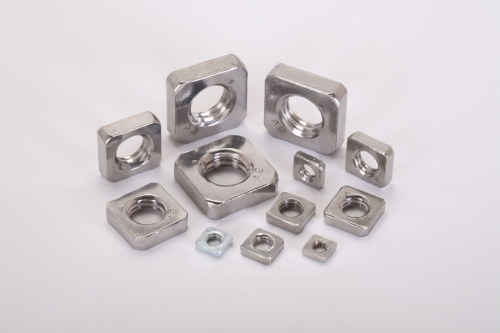
Stainless Steel Square Nut
Specification

Stainless Steel Square Nuts
The four-sided profile of a square nut makes it useful for assemblies where a matching pocket or retaining feature helps keep the nut from turning. As a stainless steel square nut supplier, PO JUN offers M5, M6, M8, and M10 sizes for equipment, brackets, furniture hardware, and fabricated components.
Each nut combines a square exterior with an internal thread for a matching bolt or threaded rod. Whether you are replacing an existing part or selecting hardware for a new assembly, the nut’s width and thickness matter just as much as its thread size.
A Four-Sided Profile for Retained-Nut Assemblies
Fits a Matching Recess or Retainer
A square nut can be housed in a suitably designed pocket, channel, or retaining feature. When the surrounding geometry restrains rotation, the bolt can be tightened from the accessible side—useful where reaching the nut with a wrench would be difficult.
Compatibility depends on the pocket dimensions and clearance. A standard square nut should not be assumed to fit every channel or extrusion system.
Broad Flats for Tool Contact
The four flat sides provide surfaces for wrench engagement where the nut remains accessible. Check the nut width and available turning space when choosing between square and hexagonal hardware.
Stainless Steel Material Selection
Stainless steel is an option when moisture exposure and corrosion influence material choice. Specify the required grade for your environment, particularly where the assembly encounters salt, cleaning chemicals, or prolonged outdoor exposure.
Available Metric Sizes
| Available Sizes |
|---|
| M5 |
| M6 |
| M8 |
| M10 |
Confirm the thread pitch, nut width, thickness, and dimensional tolerances for the selected size. The nominal thread diameter does not define the external dimensions or material grade.
Where Square Nuts Can Be Used
These nuts can be evaluated for bolted assemblies that benefit from a four-sided fastening component.
- Equipment brackets: Retain the nut behind a mounting plate where access during tightening is limited.
- Furniture and display hardware: Fit the nut into a purpose-designed recess or holder for bolt assembly from one side.
- Fabricated housings: Use a matching pocket or retaining feature to keep the nut positioned during assembly.
- Jigs and fixtures: Incorporate the nut into a replaceable threaded connection where the surrounding geometry accommodates its shape.
The retaining feature must be designed for the tightening and service loads. The square shape alone does not make the joint self-locking or establish its load capacity.
Match the Nut to the Pocket and Bolt
For a retained-nut design, allow enough clearance for insertion without leaving excessive room for rotation. Check the pocket depth, corner geometry, and bolt alignment before selecting the nut.
For replacement orders, a dimensioned drawing or sample reference helps distinguish parts that share the same M-size but differ in width or thickness. Include the mating bolt’s thread pitch and any specified nut property class so the connection can be reviewed as a complete assembly.
Request a Quote from PO JUN
Send your M5, M6, M8, or M10 size, thread pitch, stainless steel grade, and quantity. If the nut must fit an existing recess, include its dimensions or attach a drawing.
You can submit several sizes in one inquiry. Add the destination country, requested delivery date, and any packaging, labeling, or material-document requirements for quotation review.
Share your size list or retained-nut design to discuss the square nuts for your next production order.
Frequently Asked Questions
Is a square nut the same as a square washer?
No. A square nut has an internal thread that engages a bolt or threaded rod. A square washer has an unthreaded hole and is used as a bearing or spacing component.
Can a square nut replace a hex nut?
Only after checking the available space, bearing surface, thread, and required mechanical properties. The different external shape can affect tool access and fit.
Does a square nut need a cage?
Not always. It may be used with a wrench, placed in a purpose-designed pocket, or held by a separate retainer. A cage nut is a distinct assembly and should be specified separately.
How can I reduce galling with stainless steel bolts?
Use clean, undamaged threads and controlled installation speed. Where permitted, a suitable lubricant or anti-seize treatment may help; tightening torque must account for the resulting change in friction.