Stainless Steel Flange Nut
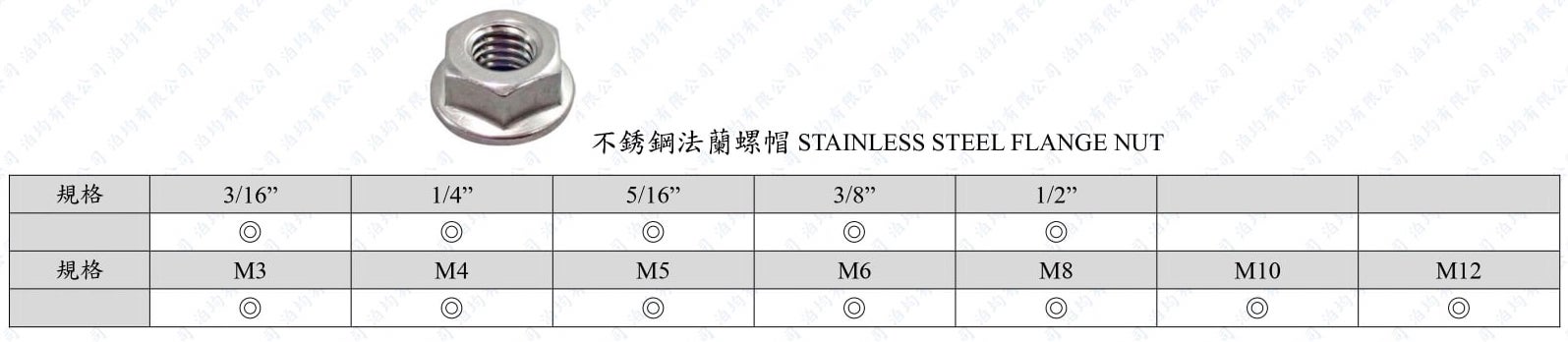
Specification
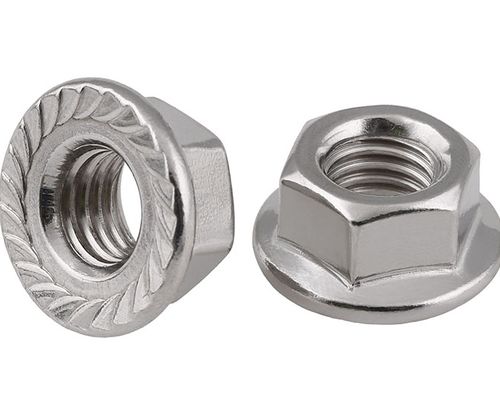
Stainless Steel Serrated Flange Nuts
Combine a hex nut and a wider bearing surface in one component. As a stainless steel flange nut supplier, PO JUN offers stainless steel serrated flange nuts in metric sizes M3–M12 and inch sizes 3/16"–1/2" for equipment, brackets, and metal assemblies.
The integral flange extends beyond the hex body, providing a broader contact area against the attached part. Serrations on the underside engage the mating surface and can help resist rotation when the joint is correctly designed and tightened.
For assemblies where a separate washer is not required, the flange design can also simplify parts handling during installation.
A Wider Base with a Serrated Contact Surface
Integral Flange
The built-in flange spreads the bearing contact over a wider area than the hex body alone. This can be useful when fastening brackets or plates, provided the flange diameter, component thickness, and hole size are suited to the joint.
Serrated Underside
The teeth on the flange face engage the mating surface during tightening. Their effect depends on surface hardness, coating, preload, and operating conditions; they should not be treated as a guarantee against loosening under vibration.
External Hex Drive
The hex body accepts a matching wrench or socket. When replacing a standard hex nut, check both the tool clearance and the space needed for the wider flange, especially near folds, corners, or recessed mounting points.
Stainless Steel Serrated Flange Nut Specifications
Available Metric and Inch Sizes
| Thread System | Available Sizes |
|---|---|
| Metric | M3, M4, M5, M6, M8, M10, M12 |
| Inch | 3/16", 1/4", 5/16", 3/8", 1/2" |
Confirm the thread pitch or threads per inch when ordering. Nominal diameter alone does not define the complete thread, flange dimensions, or nut height.
Where Flange Nuts Fit Best
Stainless steel flange nuts can be considered for assemblies that benefit from a wider bearing face and allow the serrations to contact the component.
Equipment brackets and mounting plates: Secure bolted attachments where the flange fits within the available mounting area.
Machine guards and housings: Fasten removable components where the underside contact marks are acceptable.
Metal frames and fabricated assemblies: Combine nut fastening and a broader bearing surface without handling a separate washer where the design permits.
Commercial fixtures and hardware: Join metal components where stainless steel material selection is appropriate for the service environment.
For vibration-sensitive or safety-related joints, validate the fastening arrangement under the actual operating conditions.
Check the Surface Before Choosing Serrations
The serrated face is an important part of the selection—not just a detail beneath the nut. It may leave impressions or disturb paint, plating, and other finishes during tightening.
If the assembly has a decorative surface, soft material, or a coating that must remain intact, review whether a serrated nut is appropriate. A smooth-flange design or another fastening arrangement may be a better fit.
Adding a washer also changes the contact interface: the serrations engage the washer rather than the component. That change should be reviewed as part of the joint design.
Match the Material and Thread to Your Assembly
Select the stainless steel grade around moisture, salt, cleaning chemicals, and contact with other metals. Include the required grade and nut property class if your drawing specifies them; a stainless steel description alone does not establish load capacity.
For replacement orders, send the mating bolt details or a drawing. Matching the thread pitch, flange diameter, and nut height helps avoid a part that threads correctly but does not fit the mounting space.
Request a Quote from PO JUN
Send your metric or inch size, thread pitch, stainless steel grade, and quantity. Attach a drawing or sample reference if you need to match a specific flange diameter, nut height, or dimensional standard.
You can submit multiple sizes in one inquiry. Include the destination country, requested delivery date, and any packaging, labeling, or inspection-document requirements for review.
Share your size list and assembly details to discuss the flange nuts for your next production order.
Frequently Asked Questions
Is a serrated flange nut the same as a prevailing-torque lock nut?
No. A serrated flange nut acts at the contact surface beneath the flange. A prevailing-torque nut uses a feature within the nut to resist rotation along the thread. They should not be treated as interchangeable without reviewing the joint.
Does “flange nut” mean it is intended for pipe flanges?
No. The name refers to the nut’s integral flange. Pressure-piping connections have their own material, bolting, and assembly requirements.
Can I reuse a serrated flange nut after removal?
Reuse depends on the condition of the threads, serrations, and mating surface, as well as the assembly requirements. Do not assume the original contact behavior will remain unchanged after repeated tightening.
How can I reduce galling with stainless steel bolts and nuts?
Use clean, undamaged threads and controlled installation speed. Where allowed, a suitable lubricant or anti-seize treatment may help, but tightening torque must account for the changed friction conditions.