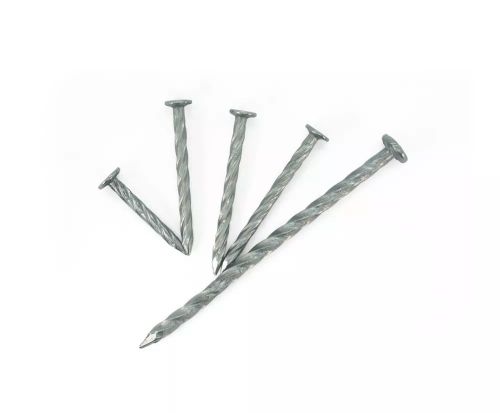
stainless steel spiral shank nails
Specification

Stainless Steel Spiral Shank Nails
For wood assemblies where nail withdrawal is a concern, the shank design matters as much as the length. PO JUN offers stainless steel spiral shank nails with a twisted profile, round head, and pointed tip for driven fastening in timber and wood products.
Also known as twisted shank nails or screw shank nails, these fasteners use a spiral profile to engage the surrounding wood. Available sizes include 12# in lengths from 1" to 2" and 10# in lengths from 2-1/2" to 4", allowing buyers to select around component thickness and the required penetration depth.
Spiral Engagement for Wood Assemblies
Twisted Shank Profile
Unlike a smooth-shank nail, the spiral profile creates additional engagement with wood fibers as the nail is driven. It is an option when selecting nails for joints that need resistance to withdrawal, although actual holding performance depends on timber species, moisture content, penetration depth, and installation conditions.
Round Head and Pointed Tip
The round head provides a bearing surface against the attached component, while the pointed tip helps start the nail at the intended fastening position. These are driven nails—not machine-thread screws—and do not require a matching nut or tapped hole.
Stainless Steel Material
Stainless steel is worth considering when moisture exposure and fastener corrosion affect the finished product. The appropriate grade depends on the environment and contact materials, including treated timber. Specify your required grade when ordering, particularly for outdoor or salt-exposed applications.
Stainless Steel Spiral Shank Nail Specifications
Available Sizes
| Size | Available Lengths |
|---|---|
| 12# | 1", 1-1/4", 1-1/2", 1-3/4", 2" |
| 10# | 2-1/2", 3", 3-1/2", 4" |
The 12# and 10# designations follow the product size chart. Confirm the actual shank dimensions against your drawing or sample rather than assuming a particular gauge system.
Where Spiral Shank Nails Can Be Used
These nails can be evaluated for wood-to-wood fastening where the joint is intended to remain assembled rather than undergo frequent removal.
- Wooden crates and packaging: Attach boards and timber components where shank engagement is part of the fastening choice.
- Furniture and workshop products: Fasten timber parts where a visible round nail head is acceptable.
- Exterior woodwork: Secure boards and trim where the selected stainless steel grade is compatible with the exposure and timber treatment.
- Timber panels and general woodworking: Match nail length to the attached component and the depth available in the receiving timber.
Structural framing, roofing, decking, and other regulated applications require the nail dimensions, material properties, and fastening pattern specified by the project design. Product shape alone does not establish approval for those uses.
Choose Around the Timber and Joint
Start with the thickness of the attached component and the penetration needed in the receiving timber. A longer nail may increase penetration, but it must not protrude through the opposite surface or conflict with hidden components.
Wood density, grain direction, and distance from an edge affect driving resistance and splitting risk. For hard timber or fastening close to an end, assess whether a pilot hole is needed. Where withdrawal performance is important, test the nail in the actual timber rather than relying only on a comparison with smooth-shank nails.
For replacement purchasing, a sample or dimensioned drawing helps match the head diameter, shank profile, and length—not just the nominal size.
Request a Quote from PO JUN
Send your 12# or 10# size, required length, stainless steel grade, and quantity. Include the timber type and whether the finished product will be used indoors or outdoors.
A drawing, existing nail sample, or photo of the joint can help clarify the required configuration. For production orders, add your destination country, requested delivery date, and any packaging or material-document needs.
Share your size list and wood-product application to discuss the nails for your next order.
Frequently Asked Questions
Are spiral shank nails the same as ring shank nails?
No. Spiral shank nails have a helical or twisted profile, while ring shank nails have a series of rings around the shank. Their engagement with the wood differs, so they should not be treated as interchangeable without reviewing the joint.
Can I install these nails with a pneumatic nailer?
Do not assume compatibility from the nail length alone. Nailers require specific head dimensions, shank dimensions, and collation formats. Confirm the tool model and nail-feed requirements before ordering for powered installation.
Can spiral shank nails be unscrewed?
They are driven fasteners, even though they are sometimes called screw shank nails. The head has no screw-driving recess, and removal may damage the timber. A screw is generally more suitable when repeated disassembly is required.
Does stainless steel prevent staining on every type of wood?
No fastener material guarantees a stain-free result in every environment. Timber chemistry, treatment chemicals, moisture, metal contamination, and stainless steel grade can all affect appearance. Test the intended combination when surface staining is a concern.